
Sa Punta Grossa lighthouse: a unique spot in north Ibiza
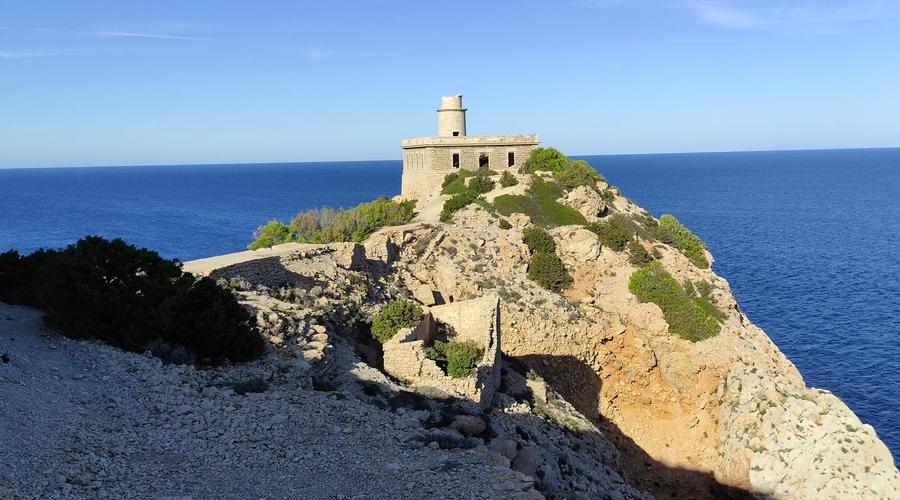
The north of Ibiza possesses a mysticism and a natural force that are a far cry from the purely festive image usually associated with the island. On this northern side, where the cliffs plunge abruptly into an untamed sea, lie hidden heritage treasures that time and neglect have shrouded in an irresistible melancholic aura. Looking ahead to this year 2026, active travelers are no longer satisfied with traditional tourist routes; they seek experiences that pose a challenge, that tell forgotten stories, and that connect physical activity with the contemplation of untouched landscapes. If there is one place that meets all these requirements outstandingly, it is the lighthouse of Sa Punta Grossa.
Situated at the northeastern tip of the island, on the imposing cape that gives it its name, this ghost lighthouse stands as a silent witness to the planning errors of the 19th century and the harshness of the seafaring life of yesteryear. Completely abandoned for more than a century, its ruins, devoured by native vegetation, exert a powerful magnetism over lovers of hiking, photography, and chronicles of shipwrecks. Visiting it is not just completing a coastal walking route; it is taking an authentic trip back in time to a hidden Ibiza that very few eyes ever get to behold.
The turbulent history of a lighthouse shrouded in controversy
To understand the heritage value of the Sa Punta Grossa Lighthouse, it is essential to delve into the annals of Balearic maritime engineering and discover the tortuous process that gave life to this building. The signal, today missing from the catalog of active lights, was originally contemplated in the ambitious Lighting Plan of 1847. The original project was designed by the famous engineer Emili Pou, who conceived a structure equipped with a third-order, small-model apparatus. Its most unique technical characteristic lay in its appearance: a fixed white light varied by eclipses every four minutes, which gave it the indisputable distinction of being the lighthouse with the slowest flashing rhythm in all the Balearic Islands.
The great debate over the strategic location
From the very moment the project was put on the table, the choice of its definitive location sparked bitter discussions between the authorities of the time and the navigators' guilds. The technical community was deeply divided between two irreconcilable positions: on the one hand, the supporters of placing the signal in the enclave called Punta Grossa, relying on landfall criteria for ships coming from the peninsula; on the other hand, the fierce defenders of locating the complex on the nearby islet of Tagomago, understanding that a light there would provide a much more efficient global service to users and, in a very special way, to local fishermen who worked in adverse conditions. Finally, the defenders of the first option won the institutional struggle, a decision that would soon prove to be erroneous.
A titanic construction marked by tragedies
Carrying out the construction of a tower and a dwelling on a cliff promontory located about two and a half kilometers away from the nearest passable path introduced monumental logistical complications. In the absolute absence of land roads, each and every one of the construction materials had to be transported by sea using barges exposed to the waves, to be subsequently hoisted by hand using pulley systems up the vertical walls of the cliff.
As if the geographical difficulties were not enough, the works were tragically interrupted by a terrible cholera epidemic that decimated the workers and paralyzed the island. In addition, once the works had begun, the engineers discovered that the stone extracted from the first selected quarry was of terrible quality, which forced them to look for new deposits and delayed the execution deadlines. Although the first lighthouse keepers arrived at the site in mid-1868 to familiarize themselves with the facilities, the official inauguration of the light could not be celebrated until September 15, 1870.
The error uncovered and the final blackout of the lighthouse
Just as the detractors of the project had warned, as soon as the complex was inaugurated, it was irrefutably proven that the location of Punta Grossa was a strategic failure: the very orography of the mountain hid the light from ships navigating through certain critical sectors. The definitive solution was none other than to agree with the old critics and build a new lighthouse on the islet of Tagomago, which came into operation in the year 1914.
However, the Sa Punta Grossa Lighthouse did not turn off its lanterns immediately; it remained in service until August 1, 1916, because the maritime authorities decided to wait until the installation of an auxiliary beacon was completed to facilitate nighttime entry into the small port of Cala de San Vicente. Two years later, in 1918, the building was officially handed over to the Ministry of Finance, beginning a century of absolute institutional oblivion and neglect that has transformed it into the romantic ruins we can explore today.
How to get to the Sa Punta Grossa lighthouse: the step-by-step route
As it is an untouched environment lacking any type of official signage, the excursion to the Sa Punta Grossa Lighthouse requires an adventurous spirit and paying close attention to the path. The land route has an approximate length of five kilometers round trip, combining flat sections with moderate climbs through a narrow path that hides among the tectonic folds of the mountain.
The start of the path in Cala de San Vicente
The ideal starting point for this adventure is to go by car or motorbike to the idyllic beach of Cala de San Vicente, where you can park your vehicle in the designated parking areas next to the sand. From the northern end of the beach, you must start the walk along the coast on foot, advancing along a residential road that runs between different holiday homes in the upper area.
The key step of the tennis court
To avoid getting disoriented in the early stages of the excursion, there is an unmistakable visual landmark: walkers must locate an old residential tennis court. Right at that point, the itinerary decisively enters a narrow path that runs squeezed between two private rustic estates. From this corridor, the asphalt disappears completely and the pure forest path that heads towards the cliff begins.
The crossing of the bridge and the final approach
As we move towards the northeast, the terrain becomes more technical and narrow. During the journey, hikers must cross a battered stone bridge which, despite its advanced state of deterioration, remains completely passable on foot if extreme caution is exercised.
The path winds upwards close to the edge of the cliffs, offering superb panoramic views where the green of the pines contrasts with the deep blue of the ocean. The path is demanding on the ankles due to the presence of loose limestone rock, which makes it completely inadvisable to do the route by bicycle due to the obvious danger of falling.
Landmarks and curiosities you will discover along the way
The walk to the Sa Punta Grossa Lighthouse is a journey punctuated by small archaeological and landscape discoveries that turn the physical effort into an authentic gift for the senses:
The great cross along the way
Halfway through the coastal journey, outlined sharply against the horizon and the sky, stands a large cross of wood and stone that surprises walkers. This rustic monument, perfectly integrated into the rugged landscape, serves as a regular resting point for hikers and marks the beginning of the most exposed and wild stretch of Punta Grossa.
Caló Gros and the lower islet
If we direct our gaze towards the base of the cliffs during the journey, we will discover the hidden and spectacular beach of Caló Gros, a small wild gravel cove where the sea beats with force. Just below the structure of the lighthouse, the islet of Punta Grossa emerges from the depths, a rocky crag that serves as a refuge for seabirds and adds an extra dose of spectacularness to the postcard-perfect landscape.
The value of photographs and silence
Since a considerable part of Ibiza's residents themselves are completely unaware of the existence of this complex in ruins due to the total absence of institutional publicity, the silence enjoyed upon reaching the tower is overwhelming. Many travelers take advantage of the total lack of overcrowding to stop in front of the sea, practice meditation, take spectacular photographs of the silhouette of the building devoured by nature, or simply let themselves be carried away by the immensity of the infinite horizon.
Practical tips to tackle the hiking route
Successfully completing this excursion along the northeastern coast of the island does not require prior experience as an expert mountaineer, but it does require acting with common sense and taking into account a series of basic safety and comfort recommendations:
Closed technical footwear and no-wheels advisory
The characteristics of the terrain, where moderate slopes, sharp stones, and narrow stretches exposed to the wind abound, require the mandatory use of comfortable, closed footwear that provides good grip, such as trail running shoes or light mountain boots. Flip-flops or beach sandals must be completely discarded. Likewise, due to the rugged relief and the proximity of vertical drops, the route is completely discouraged for bicycles or children's strollers.
Hydration and sun management
Most of the path runs through open areas that completely lack significant shade. Therefore, it is of vital importance to include in your backpack a minimum of 1.5 liters of fresh water per person, some light food or nuts to rebuild strength, a hat, and high-factor sunscreen, especially if the excursion is carried out during the summer months.
Safety in the ruins and ideal times of the year
Although the temptation to explore every corner of the dwelling of the former lighthouse keepers is very high, it is advisable to maintain a safe, prudent distance and avoid entering the roofed structures that still stand, as the walls are in a precarious state of preservation and there is a real risk of collapses. Regarding the calendar, the spring and autumn seasons are the ideal times of the year to enjoy the route thanks to their pleasant temperatures. If you decide to visit in summer, it is highly recommended to start the walk early in the morning or late in the afternoon to avoid the suffocating heat of midday and delight in the golden tones of the twilight.
Things to do in the surroundings of the northeast coast
The excursion to the Sa Punta Grossa Lighthouse can be structured as the central axis of a fantastic day dedicated to getting to know the most traditional, rural, and gastronomic Ibiza. The surroundings of the municipality of Sant Joan de Labritja and the adjacent area of San Carlos house proposals of great interest:
A refreshing swim in Cala de San Vicente
Upon returning from the walk, nothing is more appealing than taking off your sneakers and enjoying a refreshing swim in the crystal-clear waters of Cala de San Vicente. This beach, with an eminently quiet and family atmosphere, has excellent fine sand and a sensational dining offer right on the promenade, where you can taste everything from fresh fish of the day to the most typical seafood rice dishes of Ibizan gastronomy.
Hippie tradition in Sant Carles de Peralta
Just a short drive away, you will find the charming village of Sant Carles de Peralta. This rural nucleus is world-famous for hosting the historic Las Dalias hippie market, a vibrant space where craftsmanship, island-inspired fashion, live music, and the colorful stalls continue to keep alive the most free and bohemian essence of the Ibiza of the sixties and seventies.
Route through hidden coves of San Carlos
If you prefer to continue exploring the coast in search of authentic seafaring landscapes, the surroundings offer you corners of poignant beauty such as Cala Mastella, a tiny cove protected by reedbeds where absolute peace is breathed, or Pou des Lleó, a corner dotted with traditional fishermen's boathouses that preserves intact the rustic charm of the Mediterranean of yesteryear.
Discover Ibiza with Invisa Hoteles
Concluding an intense day of hiking along the cliffs of Cap des Llamp requires returning to a space that offers the maximum guarantees of rest, comfort, and attentive service. At Invisa Hotels, we put at your disposal a carefully selected choice of hotel complexes situated in the most strategic and attractive locations on the island, designed to transform into your ideal refuge during these 2026 holidays.
Our accommodations stand out for combining proximity to the most beautiful natural spots in Ibiza with first-class facilities that adapt with versatility to your style of travel. Whether you are traveling with your partner looking for a relaxing and well-being getaway, or doing so as a family or with your group of friends with the intention of practicing active tourism and discovering the most authentic side of the Pityusic Islands, in our hotels you will find the perfect atmosphere to rebuild your strength. Enjoy the tranquility of planning your routes through the lighthouses and coves of the northeast knowing that, at the end of the day, absolute comfort and a team of professionals committed to making your stay an unforgettable experience await you. Book your stay with us and come discover the best-kept secrets of Ibiza!


Categories
Invisa Blog

San Antonio de Portmany is world-renowned for the vibrant energy of its nights, the charm of its bays, and the magical sunsets that gather thousands …
Continue reading
Ibiza is world-renowned for the turquoise beauty of its coves and the dynamism of its nightlife, but the White Island harbors an equally fascinating and …
Continue reading
Forget for a moment about crowded nightclubs, frantic traffic, and crowds on the most touristy beaches. There is a different, serene, and luminous Ibiza, where …
Continue reading
Deja un comentario